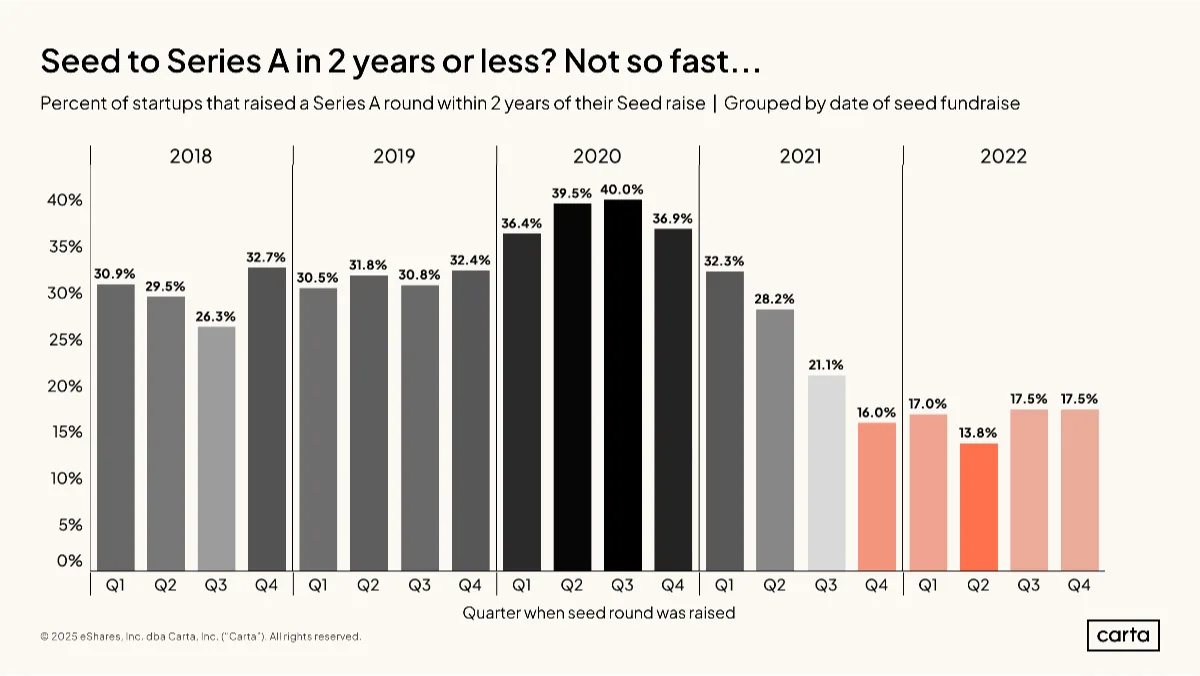
Carta estimated that about 17% of its 2022 seed cohort reached Series A within 24 months, versus roughly 25% to 30% for its 2018 cohort.
What the clock measures
The comparison fixes a 24-month window after the seed round. Companies that raise an A later can still succeed; companies that do not raise another priced round may continue operating or exit. It is neither a lifetime graduation rate nor a failure rate.
Why timing changed
The 2022 cohort entered a market in which investor requirements and valuations were shifting. Carta also recorded declining seed and Series A activity in 2024, despite a broader increase in capital raised on its platform. The route from first institutional capital to the next priced round remained selective.
Practical reading
A fundraising plan should allow for a longer path and alternatives to a quick A. The relevant milestone is evidence that fits the next investor's underwriting, supported by a cash plan that can survive a delayed process. The cohort statistic is a warning about timing, not a prediction for one company.
There is also a denominator story. A larger seed cohort can lower the percentage graduating even if the absolute number of A rounds is stable. That distinction requires matched cohort counts before making a causal claim.
Carta customers are a sample; the 2018 comparator is approximate.
Financial education, not investment or legal advice. Historical notes are retrospective analysis prepared in September 2026, not contemporaneous Venture Trace reporting.
Sources & scope
Carta
Graduation rate from seed to Series A
- Source date
- 5 Feb 2025
- Retrieved
- 16 Sept 2026
- Period / geography
- 2018 and 2022 cohorts · Carta platform
Aggregated Carta customer data
historical report snapshot. Customer sample and reporting lag; not a market census.
Carta
State of Private Markets: Q4 and 2024 in review
- Source date
- 12 Feb 2025
- Retrieved
- 16 Sept 2026
- Period / geography
- 2024 · Carta platform
Aggregated Carta customer data
historical report snapshot. Customer sample and reporting lag; not a market census.