The record
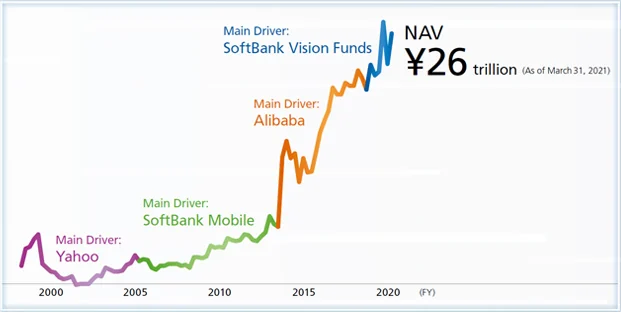
For the quarter ended 30 June 2022, SoftBank Group's consolidated financial report, published 8 August 2022, recorded a ¥2,933.8 billion loss on investments at its SoftBank Vision Funds segment and a ¥3,162,700 million net loss attributable to owners of the parent for the quarter — among the largest quarterly corporate losses reported anywhere that year. Within that figure, SoftBank itemized an unrealized valuation loss of ¥1,215.3 billion at its first Vision Fund and ¥1,341.0 billion at its second, each split between publicly listed and privately held portfolio companies.
What the sources establish
SoftBank's own breakdown shows the two halves of the portfolio being marked by different mechanics. The public-company losses, it states, came because "share prices declined in a wide range of portfolio companies, including Coupang, SenseTime, and DoorDash" — a direct, observable market price. The private-company losses, by contrast, reflected "mark-downs of those with recent funding rounds and/or weaker performance, as well as share price declines in market comparable companies" — an estimate built from proxies, not a traded price. The International Private Equity and Venture Capital Valuation Guidelines explain the mechanism behind that second category: fair value is defined, citing the FASB's ASC Topic 820 and IFRS 13, as "the price that would be received to sell an asset...in an Orderly Transaction between Market Participants," and a valuer is expected to calibrate its models to the price of a company's most recent financing round before adjusting for later market comparables.
Scope and revision
SoftBank's figures are Vision Fund segment results under IFRS, in yen, for one quarter; they are not a valuation of the broader venture market, and much of the loss reflects paper marks that can reverse later if comparables or financing rounds move the other way, as SoftBank's own subsequent reports have shown gains as well as losses. The IPEV guidelines cited here are the December 2022 edition, a living document the Board has since updated; the calibration principle they describe — anchoring to a recent round, then adjusting for market moves — is a methodology choice, not one formula, which is why two funds holding the same private company can report different marks in the same quarter.
The decision in front of you
Editorially: an employee or a later-round investor reading a headline NAV or a reported fund loss should ask whether the figure reflects a public, traded price or a private mark calibrated to a comparable or a past round, since only the first has been tested by an actual buyer.
- Does the reported valuation change reflect a public share price, a private mark, or both combined?
- What was the private mark calibrated to — a recent financing round, a public comparable, or both?
- Has the fund's methodology or the guidelines it follows changed since the figure was reported?
A ¥2.9 trillion quarterly loss is a real accounting event under IFRS, but much of it is an estimate recalibrated to moving comparables rather than a price any buyer actually paid — a distinction the guidelines governing that estimate make explicit even when a headline number does not.
Sources & reading trail
States the Vision Funds segment's total and per-fund public/private unrealized valuation losses and their stated causes.
Source published: 8 August 2022 · Retrieved: 16 September 2026
Gives the fair-value definition citing ASC 820/IFRS 13 and describes the calibration methodology for private marks.
Source published: Not established · Retrieved: 16 September 2026
Filings, provider reports and official documents establish the record; the scope reading and the decision framing are Venture Trace editorial analysis. This retrospective draft does not imply the site published on the event date.