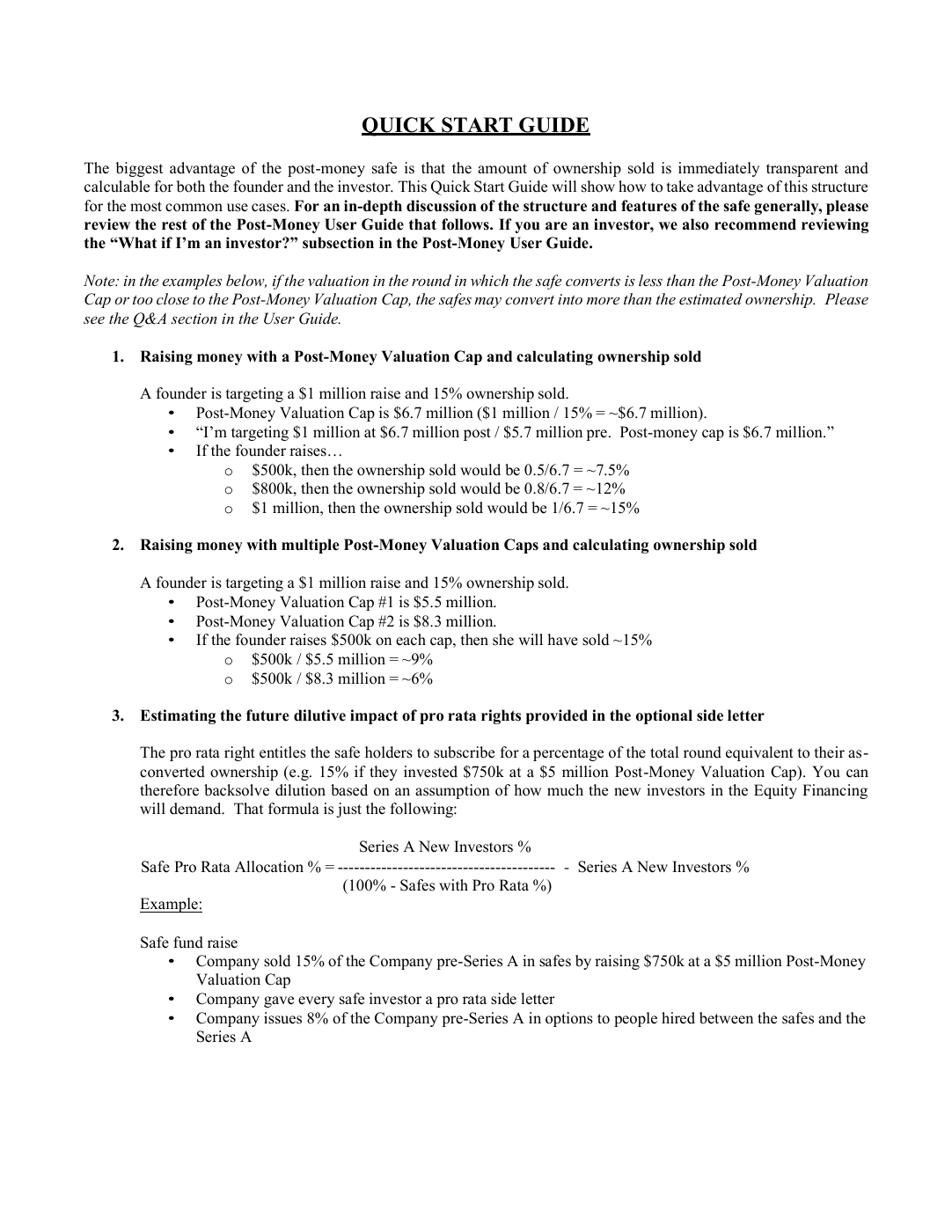
A post-money SAFE makes one part of a financing easier to see: the ownership sold on that instrument. It does not freeze the cap table through the next round.
Know which “post” you mean
YC’s post-money structure measures ownership after the SAFE financing, but before the money in the priced round and a new option-pool increase. That boundary belongs next to every quick calculation. A cap is a conversion term, not a promise of an eventual exit value.
A small, explicit example
Assume a $500,000 investment on a $10 million post-money cap, with the cap governing conversion. The simple ownership calculation is 5%. If a subsequent priced round sells 20% of the company, that stake becomes 4%, before any additional pool dilution. These are constructed numbers, not market benchmarks.
Read the complete stack
Our suggested review: list every instrument, its cap or discount, any side letter, and the financing that triggers conversion. Then reconcile the share counts as one transaction. Reviewing three documents separately can conceal their combined claim on ownership. Ask counsel to resolve the cases where the priced-round valuation falls below the cap.
Simplified cap-governed example. Discounts, lower-priced rounds, existing securities and pool changes can alter the result.
Financial education, not investment or legal advice. Historical notes are retrospective analysis prepared in September 2026, not contemporaneous Venture Trace reporting.
Sources & scope
Y Combinator
The SAFE — the open standard for startup fundraising
- Source date
- Date not stated
- Retrieved
- 16 Sept 2026
- Period / geography
- Evergreen reference · United States context
YC post-money SAFE mechanics
Page checked on retrieval date; not a historical snapshot. Educational explanation. Actual agreements, reporting conventions and jurisdictions differ.


![Illustration of coin-operated robot/2020-Global. [Dom Guzman]](/assets/source-media/cb20-cover-display.webp)